



Two critical flaws in the PHP runtime itself were disclosed on October 21, 2026: CVE-2026-109618 and CVE-2026-109619, nicknamed “PHP2Shell.” Both are CVSS 9.2 (v4.0) and can lead to unauthenticated remote code execution. Disclosure was moved up a day after the IDs leaked (PHP Foundation). The bug is in PHP core, so your framework does not matter.
The short version: update PHP to 8.5.12, 8.4.27, 8.3.36 or 8.2.35, restart every worker, and verify the running version. A WAF buys time; it is not a patch.
What is affected
Both CVEs are fixed by 8.5.12, 8.4.27, 8.3.36 and 8.2.35; older releases on those branches are affected. For older branches the sources differ:
- The GitHub advisories (GHSA-w8hw-w9fx-j79w, GHSA-6wmf-4rv5-p3rp) list 8.2 to 8.5; Google Cloud says everything from 5.4 through 8.5.11 is vulnerable (Google Cloud).
- Upstream ships no release for 8.1 or earlier, only source backports for 7.4, 8.0 and 8.1 (links below).
- Some vendors backport: Ubuntu (14.04 to 26.10, the oldest via Ubuntu Pro) and Zend (ZendPHP for 7.2 to 8.1) (Ubuntu, Zend).
Treat a vendor backport as a bridge, not a plan.
How the flaws work
CVE-2026-109618 (OOM corruption). PHP uses longjmp() to abandon a request that runs out of memory. In some contexts request memory is reachable before it is initialized, so a failed allocation leaves the request in an invalid state that shutdown then uses. Memory can be exhausted within apparent limits through multipart parsing: bodies without a usable length that slip past post_max_size, parts with unlimited headers, and empty file controls that skip max_file_uploads.
CVE-2026-109619 (stale global state). A persistent worker keeps global state pointing at request memory. If a fatal error interrupts the request before the reset, a later operation uses the freed pointer (use-after-free). It needs a producer and a consumer, usually different HTTP requests on the same worker. Confirmed consumers are INI diagnostics and session upload progress (on by default).
Impact by SAPI:
- Apache mod_php is the worst case: for 109618, shutdown runs even when startup failed, so it is reachable before application code, with default limits.
- PHP-FPM exits a child when startup fails, blunting the simplest sequence, but application-level paths remain (a session-lifecycle RCE was validated for 109619).
- FrankenPHP and LSAPI are possibly susceptible, unvalidated.
Impact: code execution as the web worker.
Is it being exploited?
The PHP team found no functional exploit among the leaked PoCs at release, but watchTowr reports exploitation attempts from October 21 and a PoC tool in circulation (watchTowr). Plan as if exploitation is active.
Reduce exposure at the edge
A WAF is a compensating control, not a fix. It does not update PHP and only matches known shapes. Akamai agrees: prompt patching is the most effective defense (Akamai). See also A WAF Is Not a Patch.
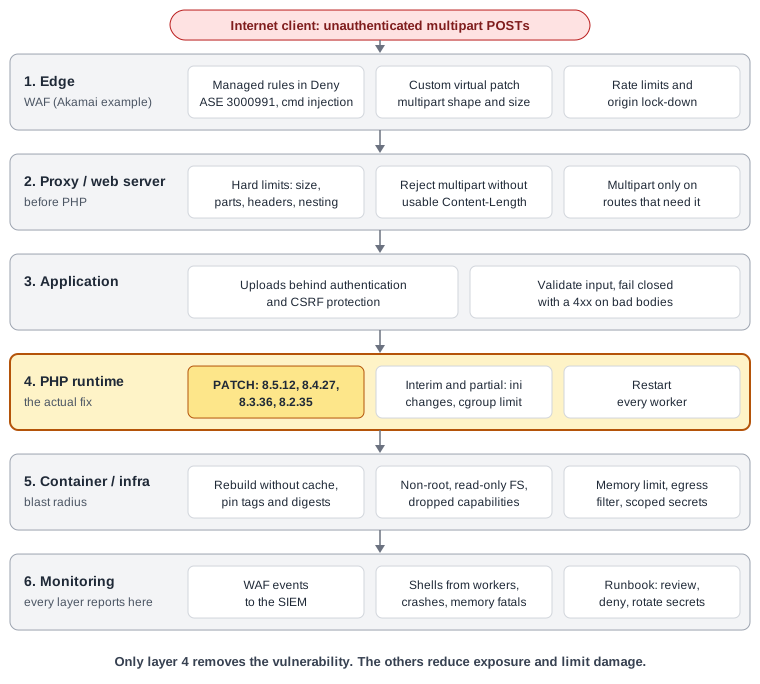
Six layers; only the fourth removes the flaw:
- Edge (WAF): managed rule, virtual patch, rate limits, origin lock-down.
- Proxy/web server: hard caps on size, parts and headers; reject multipart without a length.
- Application: authenticated uploads only where needed.
- PHP runtime: patch and restart.
- Container: non-root, read-only filesystem, memory limit, egress filter.
- Monitoring: SIEM events, host telemetry, a runbook.
Akamai as the worked example
Akamai released Adaptive Security Engine rule 3000991 and says its command-injection rules mitigate weaponized payloads.
- Prerequisites: list the policies, hostnames and paths that legitimately accept
multipart/form-data. - Managed protection: confirm rule 3000991 is in Deny, not Alert; Akamai does not state the default.
- Custom rules, Alert first:
| Rule | Purpose | Confidence |
|---|---|---|
| A. Multipart outside allow-list | Deny multipart POSTs where no uploads exist | Strong |
| B. Chunked multipart | Deny multipart with Transfer-Encoding: chunked or no Content-Length (my inference) | Strong, if no client chunks |
| C. Oversize multipart | Deny Content-Length above the per-path cap | Strong for declared length only |
| D. Upload-progress field | Alert on PHP_SESSION_UPLOAD_PROGRESS | Weak, easily renamed |
| E. Inspection gap | Alert on multipart above the WAF inspection limit | Closes a blind spot |
- Rate policy per client IP on multipart paths, since 109619 needs two requests. Start in Alert, from your observed peak.
- Roll out: baseline traffic, deploy in Alert, review daily, fix false positives by scoping the rule, then promote one rule at a time to Deny while watching 4xx and upload success.
- Lock down the origin: allow only Akamai (Site Shield, or an allow-list plus shared secret or mTLS), and verify from outside that the origin IP does not answer.
- Logging: send security events to your SIEM and alert on rule hits, multipart volume above baseline, 5xx spikes after a multipart burst, and producer-then-consumer request pairs. A shell spawned by php-fpm or Apache means compromise.
Never test with exploit code or the public PoC; send benign requests (such as curl -F 'a=1' on staging) and confirm the intended rule fired.
Patch PHP
Upgrade to 8.5.12, 8.4.27, 8.3.36 or 8.2.35 (php.net). On older branches use a vendor backport, the source backports (7.4, 8.0, 8.1), or migrate.
Distro packages keep the old version number; check the vendor tracker (Debian, Ubuntu, Red Hat), not php -v. For Docker, pin the fixed tag (such as php:8.5.12-fpm-alpine), ideally by digest, and rebuild with docker build --pull --no-cache. Scanners can miss these CVEs, since PHP in official images is not a system package.
Restart every PHP-FPM, Apache and worker process, then verify with php -v and php-fpm -v on each host and container. In CI, fail builds below the fixed PHP_VERSION. Patch internet-facing mod_php first. If compromised, rotate secrets and rebuild from clean images.
If you run PHP 8.1 or older, how long will your migration take?
References: GHSA-w8hw-w9fx-j79w, GHSA-6wmf-4rv5-p3rp, PHP Foundation, Google Cloud, Akamai, watchTowr.